Limited Time Only - 7 day starter pack just £12.00
How to Choose the right hydration product
If you've stood in front of a shelf (or scrolled a search page) trying to pick an electrolyte powder, you've probably noticed something strange: almost every product claims to do the same thing. Rehydrate you. Replace electrolytes. Stop cramping. Support performance. But here's what nobody in this category is telling you clearly enough: your hydration needs change depending on what you're actually doing. The electrolyte demands of the two hours before a race are not the same as the demands of a normal training day, and they're nothing like what your body needs in the 24 hours after you've broken it down through hard effort or heat stress. Most products on the market are built to answer one question - "how do I replace what I sweat out?" - with one formula. That's the old model. I think it's outdated, and I want to walk you through why, so that by the end of this you'll be able to choose an electrolyte powder based on what your body is actually doing, not just what's on the front of the tub.
Kye
7/15/20267 min read
How to Choose the Right Electrolyte Powder for Your Needs
If you've stood in front of a shelf (or scrolled a search page) trying to pick an electrolyte powder, you've probably noticed something strange: almost every product claims to do the same thing. Rehydrate you. Replace electrolytes. Stop cramping. Support performance.
But here's what nobody in this category is telling you clearly enough: your hydration needs change depending on what you're actually doing. The electrolyte demands of the two hours before a race are not the same as the demands of a normal training day, and they're nothing like what your body needs in the 24 hours after you've broken it down through hard effort or heat stress.
Most products on the market are built to answer one question - "how do I replace what I sweat out?" - with one formula. That's the old model. I think it's outdated, and I want to walk you through why, so that by the end of this you'll be able to choose an electrolyte powder based on what your body is actually doing, not just what's on the front of the tub.
The Old Model: Sodium Follows Sugar
Most electrolyte and hydration products, whether they admit it or not, were built on a simple industrial logic: sodium follows sugar.
Add sugar (or a sugar-based carbohydrate blend) as the base, because sugar helps carry fluid and electrolytes across the gut wall via co-transport mechanisms. Then add sodium and a bit of potassium on top, because that's what sweat contains. Flavour it, package it, done. It's why so many "hydration" products are, nutritionally, closer to a sports drink than an electrolyte solution - sugar-first, electrolytes as an afterthought riding on its back.
This isn't necessarily wrong - sugar-assisted transport is real physiology. But it's incomplete, and it treats every hydration occasion the same way: as a single problem with a single fix. It ignores three things I think matter enormously:
Electrolyte needs are not static. What you need before you start is different to what you need mid-effort, which is different again to what you need once you've stopped.
You can hydrate faster and deeper than the sugar model allows, if you get the transport mechanism right.
The gut is not a passive pipe. Under heat and physical stress, it's often the actual limiting factor in how well you hydrate and almost nobody is designing for it.
Let's take these one at a time, because they're the foundation of a genuinely different way to think about this category.
Principle 1: There Are Three Distinct Physiological States, Not One
Think about what your body is actually doing across a training or event cycle. It's not one continuous state — it moves through phases, each with a different physiological job:
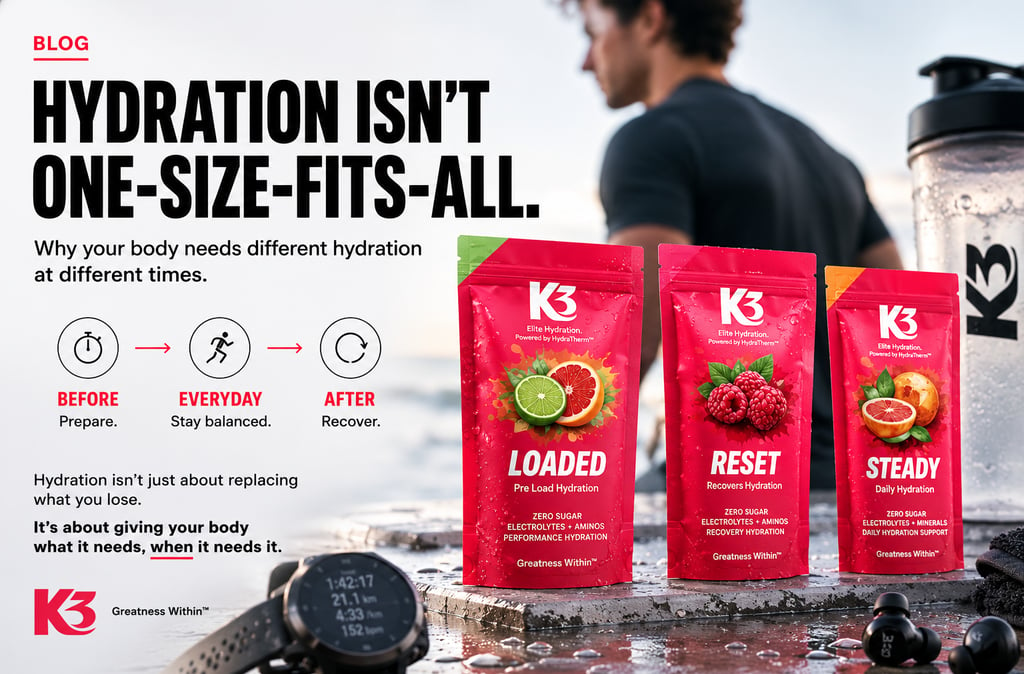
State 1 Pre-Load. Before you start, your job is to get ahead of the deficit: build electrolyte and fluid reserves so you're not starting already behind. This calls for a different, often more concentrated electrolyte profile than what you'd sip mid-session.
State 2 Maintenance. During activity or across a normal demanding day, your job is steady-state replacement - matching ongoing electrolyte and fluid losses without overloading the gut or diluting sodium levels through excess plain water.
State 3 Recovery. After the effort, your job shifts entirely: rebuilding depleted stores, supporting the repair process, and preparing the body for the next session or event. This is a different biochemical environment to the other two, and treating it with the same formula you used beforehand is a missed opportunity.
A single-formula electrolyte powder is being asked to do three different jobs it was never designed for. It's a bit like using the same tool to loosen a bolt, tighten it, and then polish it. It'll sort of work in each case - but it's not optimised for any of them.
Illustrative example: Picture an office worker who trains after work most days. Their "pre-load" need (a desk-bound, air-conditioned afternoon) looks nothing like an ultra-endurance athlete's pre-load need (hours in extreme heat, high sweat rate, elevated cortisol). Same category of need - very different scale and composition of it. A one-size formula can't flex between those two people, let alone flex for the same person across a training week.
Principle 2: The Osmolyte Layer - Hydration Doesn't Stop at the Gut Wall
Here's where it gets more interesting than "electrolytes in, sweat replaced."
Sugar-assisted transport gets fluid and electrolytes across the gut wall and into the bloodstream. But getting into the bloodstream isn't the same as getting into the cell, where hydration actually needs to happen for muscle function, nerve signalling, and thermoregulation to work properly.
This is where amino acids come in. Certain amino acids act as osmolytes - they help draw electrolytes and fluid across cell membranes more efficiently than sugar-based transport alone, working with the osmotic gradient (the concentration balance between inside and outside the cell) rather than relying purely on the gut-to-bloodstream sugar pathway. The practical effect: hydration that reaches the cellular level faster, and — because it's not dependent on a sugar spike to do the work - lasts longer without the crash-and-redose cycle that sugary hydration products often create.
This matters more than it sounds. Fluid sitting in your bloodstream doesn't stop you cramping or overheating - fluid and electrolytes inside your muscle cells do. An amino-acid-supported, osmolyte-driven approach is aiming at a deeper, more physiologically relevant target than most "just add sodium" formulas ever reach.
Illustrative example: Two cyclists do the same three-hour ride in the heat. One relies on a sugar-based drink, sipping constantly because the hydration effect is short-lived and needs topping up. The other has properly hydrated at the cellular level beforehand and during the ride and finds they simply need less fluid on the bike, because what they've taken in is doing more work, for longer, at the level that actually matters.
Principle 3: The Gut Is a Performance Organ, Not a Pipe
This is the piece I think the entire category has ignored, and it might be the most important one.
Heat and physical stress don't just cause you to lose electrolytes through sweat - they also compromise gut function. Under heat load, blood flow is redirected away from the gut toward the skin and working muscles, reducing gut blood supply and increasing gut permeability. This is often described as heat-induced gastric or gut stress, and it's a major, underappreciated cause of the nausea, cramping, and "my stomach just shut down" experiences that endurance athletes know all too well.
Here's the disconnect: if your gut is compromised, it doesn't matter how well-designed your electrolyte formula is - it can't be absorbed properly if the gut itself is under stress. You can have the most elegant sodium-potassium-osmolyte balance in the world, and it still won't help you if your gut is the bottleneck.
This is why supporting gut integrity - not just electrolyte delivery - has to be part of a serious hydration strategy, particularly for anything in heat, over long durations, or under high physical stress. Ignore it, and you're optimising the wrong end of the pipeline.
Real case study: Ultra-runners competing in an extreme multi-day jungle ultra event - heat, humidity, and days of accumulated physical stress, exactly the conditions where gut shutdown typically wrecks performance - completed the full five days using our protocol with zero reported cramping or gut issues. That's not a coincidence; it's what happens when you design for the gut as deliberately as you design for the electrolyte profile.
The Decision Framework: Which State Are You In?
Before you look at a single ingredient label, ask yourself where you actually sit right now. Most people find they need support across more than one of these, at different points in their week.
If you read that and thought "actually, I need all three at different points in my week" - that's not a coincidence. That's most people who train seriously, and it's exactly the gap a single-formula product can't close.
How We've Built K3 Around This
I started K3 Hydration because I kept seeing the same gap: brilliant athletes and everyday people being sold one formula to solve three different physiological problems, with almost nobody addressing the gut side of the equation at all.
We built K3 as a three-stage system rather than a single product, because I don't think a single formula should be asked to do three different jobs:
Loaded - our pre-load formula, citrus, - built to get you ahead of the deficit before demand hits.
Steady - our maintenance formula, orange, - built for balanced, ongoing replacement without overloading the gut.
Reset - our recovery formula, berry, - built for rebuilding after the effort is done.
Underpinning all three is what we call HydraTherm Technology our approach to layering electrolyte delivery with amino-acid-supported cellular (osmolyte) hydration and gut-support elements, rather than relying on sugar to do the work. It's the same thinking behind our zero-sugar formulation across the whole range: we didn't want sugar as the transport mechanism, so we built the system around amino acids and osmolarity instead.
We've seen this play out with real athletes: Ironman competitors reporting quicker recovery turnarounds between training blocks using our Reset-led recovery protocol. Cyclists following the full protocol finding they need to drink less on the bike, not more, because they arrive properly cellular-hydrated and the in-race hydration is doing more effective work. And the ultra-runners I mentioned earlier, completing five days of an extreme jungle ultra with zero cramping or gut issues - which, if you've ever run an ultra in the heat, you'll know is not a small thing.
Our tagline is "Greatness Within" - and I think that's genuinely what this comes down to. Hydration that works isn't about what's easiest to sip. It's about what actually reaches the cells and organs doing the work, at the stage of the process you're actually in.
Where to Start
If you're new to electrolytes, or you've read all this and you're still not sure exactly where you sit - start simple. Our 7-Day Starter Pack gives you all three formulas (10 sachets) so you can experience Loaded, Steady, and Reset across a real week and feel the difference between the states for yourself, rather than guessing from a label.
If you're already training with a specific plan or event in mind, and you know roughly where your pre-load, maintenance, and recovery demands sit, go straight to Build Your K3 System and enter your training plan - we'll tailor your supply to the states you actually need, in the quantities your training calls for.
Either way, the goal is the same: stop treating hydration as one problem with one fix, and start matching what you take in to what your body is actually doing.
Experience the worlds 1st Physiological Hydration System.
© 2026. All rights reserved.
SHOP NOW - Find 'Greatness Within'
LEARN MORE
GREATNESS WITHIN · HYDRATHERM™ · GUT LED physiological HYDRATION SYSTEMS